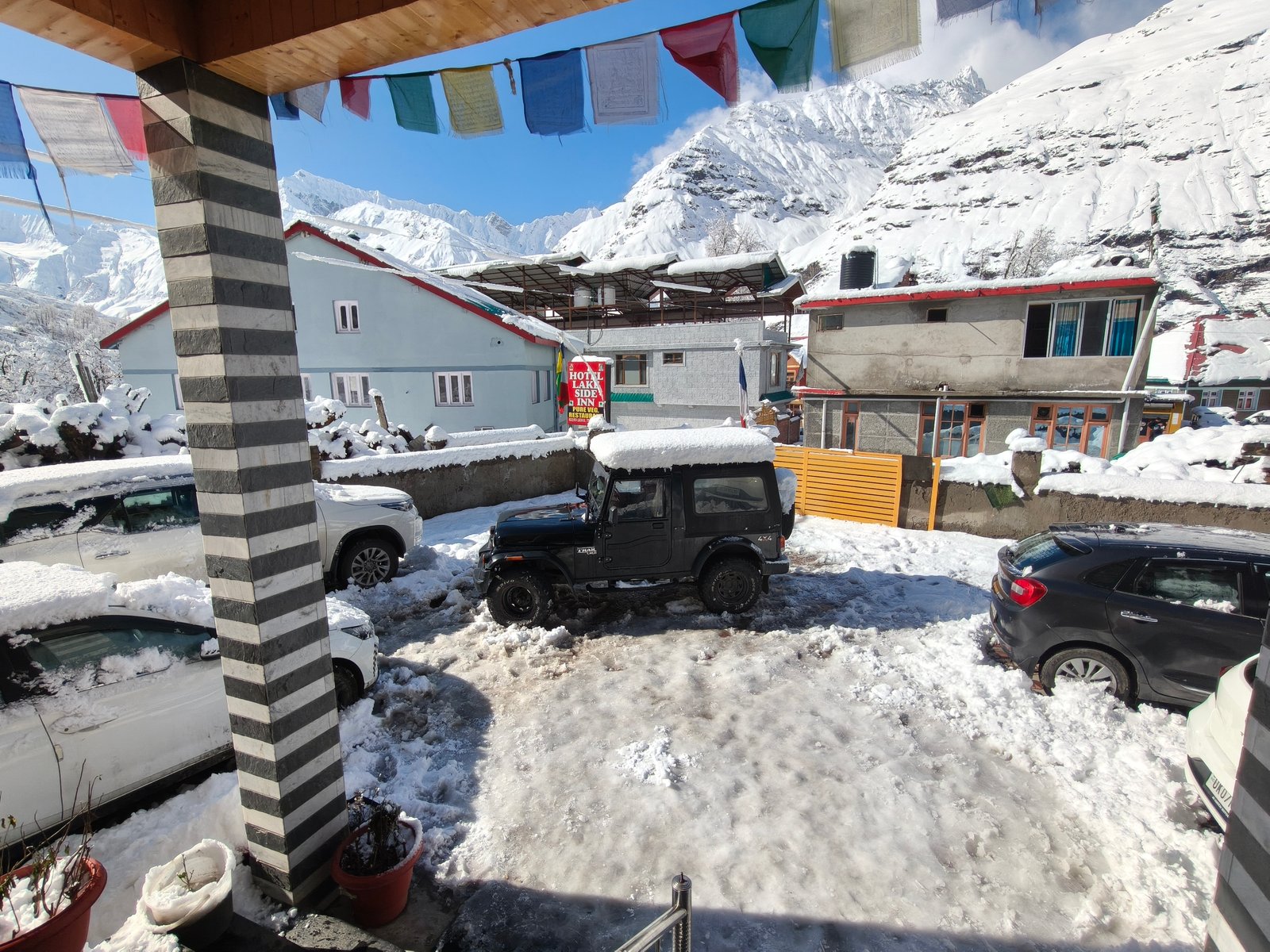
The Lahaul valley is a high, arid, rain-shadow region of Himachal Pradesh sitting above 3,000 m, hemmed in by the Pir Panjal and the greater Himalaya and drained by the Chandra and Bhaga rivers. Once cut off by winter snow, it is now reachable year-round through the Atal Tunnel from Manali. The easiest base for a first visit is Sissu, the first proper village past the tunnel — where we run Hotel Lake Side Inn, a 2-minute walk from Sissu Lake.
Where Lahaul is & what it’s like
Lahaul is the western half of the Lahaul & Spiti district, tucked behind the Pir Panjal range directly north of Manali. Because those mountains block most of the monsoon clouds, Lahaul sits in a rain shadow: it is dry, cold and starkly beautiful, closer in feel to Ladakh than to the green hills of Kullu you drive up from. Expect bare brown-and-grey ridges, hanging glaciers, blue rivers and, in spring, thin ribbons of green barley and pea fields around each village.
The valley floor mostly runs between about 3,000 and 3,300 metres, so the air is thin and the sun is fierce by day while nights stay cold even in summer. The Chandra river runs down the eastern arm past Sissu and Koksar; the Bhaga comes down the northern arm past Keylong and Jispa; the two meet at Tandi to form the Chandrabhaga (Chenab). Understanding those two river arms is the simplest way to picture how the whole valley is laid out.
The main villages of Lahaul
Lahaul is a scatter of small farming villages rather than towns. From the tunnel, working up the valley, these are the ones travellers actually pass through or stop at:
- Koksar — the first hamlet after the tunnel on the way to Spiti, a check-post and a couple of dhabas beside the Chandra, ~14 km from Sissu.
- Sissu — a broad, green village on the valley floor with its own lake and a tall waterfall; the most convenient first stop and where we are based.
- Gondhla — famous for its eight-storey timber-and-stone Gondhla Fort, the old seat of the local thakurs.
- Keylong — the district headquarters (~30 km), the largest settlement, with markets, an ATM, fuel nearby at Tandi and the Kardang and Shashur monasteries close by.
- Jispa & Darcha — on the Bhaga toward Baralacha La and Leh (~50 km), popular for riverside camps and as an acclimatisation stop.
- Udaipur — down the Pattan (Chandrabhaga) valley, gateway to the revered Trilokinath and Mrikula Devi temples.
For a spot-by-spot rundown of what to actually see, read our companion guide to places to visit in Lahaul valley.
How the Atal Tunnel changed everything
For most of Lahaul’s history the only road in from Manali climbed over the Rohtang Pass (~3,980 m), which snow closed for roughly half the year and which even in summer meant hours of slow, weather-dependent driving. Villages north of the pass were effectively cut off from the rest of Himachal each winter.
The Atal Tunnel — a 9.02 km highway tunnel beneath the range, opened in October 2020 and the world’s longest highway tunnel above 10,000 ft — changed that overnight. Its south portal is near Dhundi above Manali; the north portal opens onto Lahaul near Teling, just before Sissu. The tunnel is free, has a 60 km/h limit and forbids stopping or photography inside, and it keeps Lahaul reachable through most of the year. The valley you once had to earn over a pass is now a comfortable hour’s drive from Manali. If you want the fuller comparison, see Atal Tunnel vs Rohtang Pass.
How to reach Lahaul
Almost everyone enters Lahaul from Manali through the Atal Tunnel. From Manali it is roughly 38–40 km (about an hour) to Sissu, then onward: Keylong ~30 km further, Jispa ~50 km, and Kaza in Spiti ~190–200 km via Kunzum La. The nearest airport is Bhuntar (Kullu), about 90 km from Sissu; the nearest big railheads are Chandigarh and Pathankot, both a long road day away.
- Fly or train to Bhuntar / Chandigarh, then road to Manali.
- Manali to Lahaul by taxi, self-drive or HRTC bus through the tunnel — the drive to Sissu is easy and mostly tarred.
- Onward within Lahaul toward Keylong, Jispa, Udaipur or Spiti as your trip demands.
For step-by-step transport options and fares, see how to reach Sissu and Manali to Sissu taxi & bus fares. If your main aim is to sleep close to the tunnel on the Lahaul side, our guide to hotels near the Atal Tunnel lays out the choices.
When to go
The reliable season is June to September, when all the valley roads — including the high passes to Chandratal, Spiti and Leh — are open and days are pleasant. May and early October are lovely shoulder months on the valley floor, though the highest passes may still be shut. December to February brings heavy snow, deep cold and occasional route restrictions, but also the quiet, white Lahaul that snow-lovers come for.
Note that Lahaul’s administration sometimes suspends winter tourist movement for a stretch (roughly late January to end February) around heavy snow and the local Halda festival; the exact dates vary year to year, so confirm before a deep-winter trip. We keep a fuller breakdown in our best time to visit Lahaul guide, and a Sissu-specific version in best time to visit Sissu.
Where to base yourself
For a first trip — or any trip where you want one comfortable base and easy day-runs — Sissu is the sensible choice. It is the first green, level village past the tunnel, it has its own lake and waterfall, it is only ~12 km from the north portal, and it sits directly on the road toward Keylong, Jispa, Chandratal and Spiti, so most of the valley is a day-trip away.
That is exactly where Hotel Lake Side Inn sits, on the valley floor about two minutes’ walk from the lake. A stay gives you mountain-view rooms, 24×7 hot water, room heaters, free parking and a 100% pure-veg kitchen — the practical comforts that matter at 3,100 m. Browse our rooms, and if you eat strictly vegetarian, our pure-veg restaurant in Lahaul page explains how we cook. To plan dates or ask about road and snow conditions, just get in touch.
Things to know before you go
- Fuel is scarce. There is no petrol pump in Sissu — fill up in Manali. Tandi (~22 km, near Keylong) is the last pump before the long ~360 km stretch toward Leh/Spiti with no fuel after it.
- Altitude is real. The valley floor is above 3,000 m; take it easy on day one and read Sissu altitude & AMS before you climb higher toward Chandratal or Baralacha.
- Permits. Indian travellers need no permit for Lahaul — just carry a government photo ID.
- Cash & network. ATMs and reliable signal are limited outside Keylong; carry some cash and don’t rely on data everywhere.
- Weather rules the roads. Even in summer, landslides and clearance work on the Manali side can cause delays; check conditions before you set off.
Frequently Asked Questions
Where is the Lahaul valley?
Lahaul is a high, arid valley in Himachal Pradesh, directly north of Manali across the Pir Panjal range. It forms the western half of the Lahaul & Spiti district, drained by the Chandra and Bhaga rivers, with Keylong as its headquarters. It is reached from Manali through the Atal Tunnel.
How do you get to Lahaul?
Almost everyone drives in from Manali through the Atal Tunnel. Sissu, the first main village, is about 38–40 km (roughly an hour) from Manali. The nearest airport is Bhuntar (Kullu), ~90 km from Sissu. You can travel by taxi, self-drive or HRTC bus.
Is Lahaul open in winter?
Mostly yes — the Atal Tunnel keeps Lahaul reachable through most of the year, unlike the old Rohtang route. However, heavy snow from December to February can cause restrictions, and tourist movement is sometimes suspended for a stretch around late January to February. Confirm conditions before a deep-winter trip.
What is the best time to visit Lahaul valley?
June to September is the reliable season, with all roads and high passes open and pleasant days. May and October are good shoulder months on the valley floor. December to February offers snow but cold and some closures. See our best time to visit Lahaul guide.
Which villages are worth visiting in Lahaul?
The main ones are Sissu, Koksar, Gondhla, Keylong, Jispa and Udaipur, plus the monasteries and temples around them. Sissu makes the easiest base, with Keylong as the district hub. Read our places to visit in Lahaul guide for details.
Do I need a permit for Lahaul?
Indian travellers need no permit for Lahaul, including Sissu — just carry a valid government photo ID. Foreign nationals follow standard rules; there is no special inner-line permit for the main Lahaul villages. Permits only become relevant for certain restricted areas further out.
Base your Lahaul trip in Sissu
Mountain-view rooms, 24×7 hot water, heaters and a pure-veg kitchen on the Lahaul valley floor — 2 minutes from Sissu Lake. Book direct.