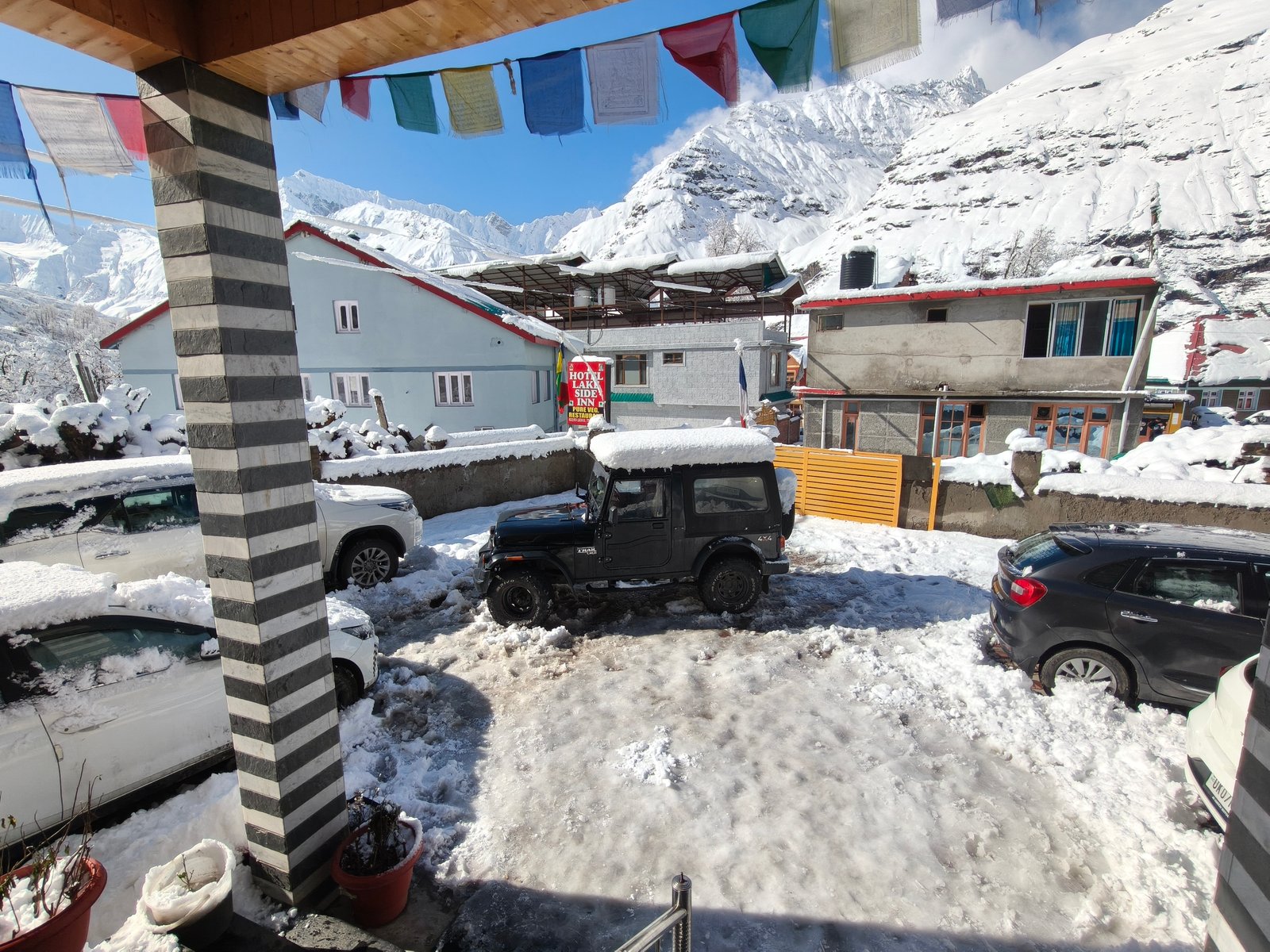
The best places to visit in the Lahaul valley are Sissu Lake & Waterfall, Koksar, Keylong, Kardang Monastery, Gondhla Fort, Jispa, Trilokinath Temple, Chandratal, Suraj Tal and Baralacha La — a mix of lakes, monasteries, forts and high passes strung along the Chandra and Bhaga rivers. Most are easy day-trips or stops if you base yourself in Sissu, where we run Hotel Lake Side Inn beside the lake.
Around Sissu & Koksar
The valley’s most accessible sights sit right where you first enter Lahaul. Sissu Lake is a calm, mountain-backed pool on the valley floor, at its prettiest when the peaks reflect in still morning water — a short stroll from the village. Directly across the Chandra, the Sissu Waterfall (Palden Lhamo Dhar) drops in a long white ribbon off the cliff, fullest from late spring through summer. Both are two minutes from our door; see Sissu Lake and Sissu Waterfall for the detail.
Koksar, ~14 km on toward Spiti, is the first Lahaul hamlet after the tunnel — a river bridge, a check-post and a couple of dhabas famous among riders for a hot plate of Maggi in a stark, windswept setting. It is one of the coldest inhabited spots in the valley, catching wind straight off the surrounding snowfields, and it works best as a natural photo stop rather than a destination in itself. Many travellers pause here on the way to Chandratal or Spiti to warm up before the harder road ahead. For everything within Sissu itself, our things to do in Sissu guide covers the lot — the lake, the waterfall, the Raja Gyephang temple and the sunset point above the village.
Keylong & its monasteries
Keylong (~30 km, about an hour) is Lahaul’s district headquarters and its only real town — a hillside market with shops, an ATM, guesthouses and government offices, set among terraced fields above the Bhaga. It is worth a visit both for supplies and for the cluster of Buddhist monasteries nearby. Kardang Monastery, perched across the Bhaga a few kilometres from Keylong, is the most important gompa in Lahaul, home to old murals, a large prayer wheel said to hold sacred scriptures, and sweeping valley views. Shashur (known for its tall thangkas and a June masked-dance festival) and Tayul monasteries are also within reach on the same day. These are living monasteries where monks study and pray, so dress modestly, remove shoes where asked, and follow their lead inside.
Keylong also makes a practical mid-point: if you are pushing on toward Jispa, Baralacha or Leh, it is the last town with proper amenities, and the fuel stop at Tandi sits on the way. Pair it with Gondhla Fort just down the road for a full, rewarding day out from Sissu.
Gondhla Fort
Between Sissu and Keylong, near Gondhla village (~14 km from Sissu), stands the striking Gondhla Fort — an eight-storey tower of timber and stone that was the seat of the local thakur (chieftain). Its stacked wooden galleries and the old relics associated with it make it one of Lahaul’s most photogenic heritage sites, and an easy add-on to a Keylong day-trip. Read our dedicated Gondhla Fort guide before you go.
Jispa & the Bhaga arm
Beyond Keylong the road forks up the Bhaga toward Leh. Jispa (~50 km from Sissu) is a broad riverside village popular for its camps and as an acclimatisation halt on the Manali–Leh highway. It is calmer and higher than Sissu, good for a night if you are heading further north. Just before it, Tandi holds the valley’s last petrol pump — the final fuel for a very long stretch toward Leh and Spiti, so top up there. Deciding between bases? Our Sissu vs Keylong vs Jispa comparison helps.
Trilokinath & the Pattan valley
Down the Chandrabhaga (Pattan) valley toward Udaipur (~50+ km) lies the revered Trilokinath Temple, worshipped by both Hindus and Buddhists — a rare shared shrine set among green fields and orchards. The nearby Mrikula Devi Temple is prized for its intricate wood carving. This softer, greener arm of Lahaul is a rewarding full-day drive from Sissu when the valley floor is snow-free.
The high country: Chandratal, Suraj Tal & Baralacha La
For many travellers, Lahaul’s headline sights are its high-altitude lakes and passes — all strictly summer-only (roughly June to September) and all serious altitude:
- Chandratal (~85 km, ~4,300 m) — the crescent-shaped “Moon Lake” reached via the Batal/Kunzum route, one of Himachal’s most beautiful spots. See Sissu to Chandratal for the route and timing.
- Suraj Tal — a high sacred lake near the top of Baralacha La on the Leh road, source of the Bhaga river.
- Baralacha La (~4,890 m) — a dramatic pass on the Manali–Leh highway, often snow-lined even in summer.
These are long, tiring days on rough roads; go only when you are acclimatised, start early, and carry warm layers, water and snacks.
Distances at a glance
| Place | Distance from Sissu (approx) | Highlight |
|---|---|---|
| Sissu Lake & Waterfall | ~2-min walk | Calm lake & cliff waterfall |
| Koksar | ~14 km | First hamlet, river & dhabas |
| Gondhla Fort | ~14 km | 8-storey timber tower |
| Keylong | ~30 km | District town & markets |
| Kardang Monastery | ~30+ km | Lahaul’s chief gompa |
| Jispa | ~50 km | Riverside camps |
| Trilokinath Temple | ~50+ km | Shared Hindu-Buddhist shrine |
| Chandratal | ~85 km | High “Moon Lake” |
How to plan it
A comfortable plan is to base in Sissu and radiate out: an easy first day at the lake and waterfall while you acclimatise, a Keylong–Gondhla–Kardang loop on day two, and a bigger push to Jispa, Trilokinath or Chandratal once you have your mountain legs. Because Sissu is central and directly on the highway, you avoid packing and re-packing at every stop.
That is the case for Hotel Lake Side Inn as a hub: mountain-view rooms with 24×7 hot water, heaters, free parking and a pure-veg kitchen, two minutes from Sissu Lake. Tell us your route and dates when you get in touch and we’ll advise on distances, road status and realistic day-trips. For the wider region overview, start with our Lahaul valley tourism guide.
Frequently Asked Questions
What are the top places to visit in Lahaul valley?
The standouts are Sissu Lake & Waterfall, Koksar, Gondhla Fort, Keylong, Kardang Monastery, Jispa, Trilokinath Temple, Chandratal, Suraj Tal and Baralacha La. They range from an easy lakeside stroll in Sissu to serious high-altitude passes and lakes that only open in summer.
How many days do you need for Lahaul?
Two to three days covers the accessible sights — Sissu, Gondhla, Keylong and its monasteries. Add a day or two if you want to reach Jispa, Trilokinath or Chandratal, which involve longer, higher drives. Basing in Sissu keeps the day-trips manageable.
Is Chandratal open all year?
No. Chandratal (~85 km from Sissu, ~4,300 m) is reachable only in the summer season, roughly June to September, once the high passes clear of snow. In winter the route is closed. See our Sissu to Chandratal guide for timing.
What is the most important monastery in Lahaul?
Kardang Monastery, across the Bhaga near Keylong (~30+ km from Sissu), is the chief gompa of Lahaul, known for old murals and a large prayer wheel. Shashur and Tayul monasteries near Keylong are also worth visiting.
Which place is best as a base for sightseeing?
Sissu is the most convenient base — it is the first green village past the Atal Tunnel, has its own lake and waterfall, and sits centrally on the highway toward Keylong, Jispa and Chandratal, so most sights are day-trips. Compare options in Sissu vs Keylong vs Jispa.
Are the high passes safe to drive?
In summer they are open but demanding — high, rough and weather-dependent. Baralacha La is nearly 4,900 m. Only attempt them once acclimatised, start early, carry warm layers and fuel up at Tandi. Check road conditions locally before you go.
See all of Lahaul from one base
Stay in Sissu — central for Keylong, Gondhla, Jispa and Chandratal day-trips, with mountain-view rooms and a pure-veg kitchen. Book direct.