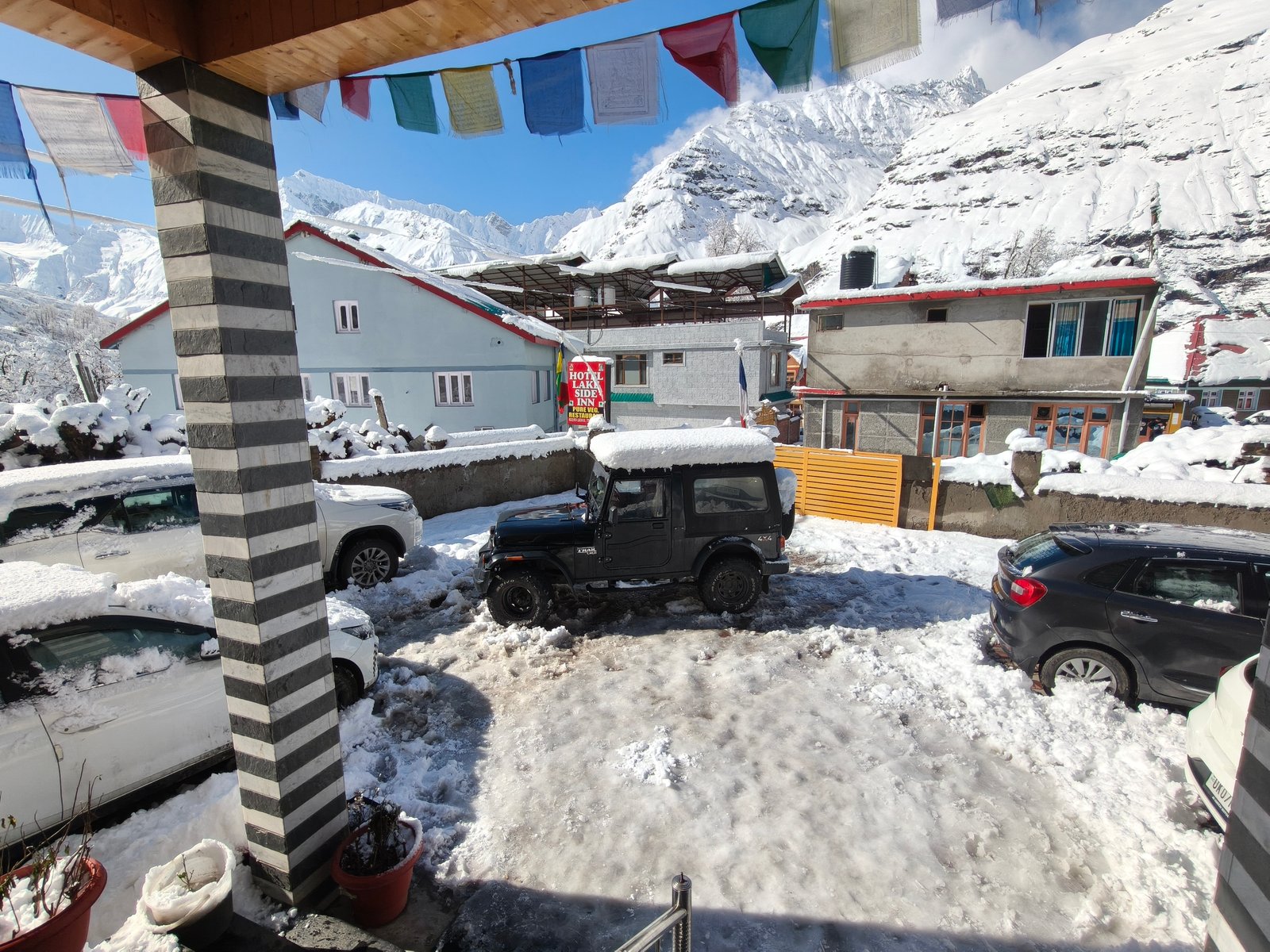
The best-known snow spots near Manali are Solang Valley and the Atal Tunnel area, with Rohtang Pass a seasonal summer option — but for reliable valley-floor snow without the Manali-side crowds, Sissu, about 38–40 km away through the tunnel, is one of the best quiet snow bases, holding snow through much of winter. Below we lay out honestly where snow actually falls, when each spot gets it, and how to pick the one that suits your trip — then why we think Sissu makes such a calm, comfortable base for it.
Where to find snow near Manali
Manali town itself sits at about 2,050 m, so it only sees occasional snow in the depths of winter and rarely holds it for long. To find snow you can actually walk in and play with, you climb higher or cross to the Lahaul side of the mountains. The main options, roughly in order of how close and how popular they are, are Solang Valley, Gulaba, the Atal Tunnel area and Sissu, and — in summer only — Rohtang Pass.
As for timing: the first proper snow usually arrives on the higher points around late November into December, builds through January and February, and lingers into March before the thaw. Early in the season the snow sits high and you may have to drive up to reach it; by mid-winter it settles lower and, on the Lahaul side, right down onto the valley floor. Snowfall varies year to year, so treat these as typical windows rather than a promise for any given week.
Solang Valley — popular, busy, adventure
Solang Valley, about 13 km from Manali, is the classic day-trip for snow and the one most visitors head to first. It is the hub for winter activity — skiing, snow tubing, sledging, the ropeway — and in season it buzzes with energy. If you want snow with a side of adventure and do not mind a crowd, Solang delivers.
The trade-off is exactly that popularity. On peak-season weekends Solang can get very busy, with slow traffic on the approach, packed slopes and a queue for almost everything. Early snow can also sit above Solang itself, so operators sometimes ferry visitors further up to reach it. It is a fun, lively snow day — just go in expecting company. For a head-to-head on how the mood compares with the Lahaul side, see our Sissu vs Solang Valley guide.
Atal Tunnel area & Sissu — quieter, reliable valley snow
Cross under the mountains through the Atal Tunnel and you reach the Lahaul side, where the snow is a different experience altogether. The tunnel’s north-portal area and the run down to Sissu hold snow reliably through winter, and because Sissu sits at about 3,100 m on the valley floor, the snow settles right where you stand rather than only on the slopes above. That means easy, level snow — no long uphill drive to reach it once you are here.
Crucially, this side stays far quieter than Solang. The tunnel keeps access open for much of the year, the drive from Manali is only about 38–40 km (roughly 1–1.5 hours), yet the crowds thin dramatically the moment you emerge on the Lahaul side. For most people chasing snow, that combination — reliable valley-floor snow, easy access, and calm — is the sweet spot. Read our Sissu snow point guide for exactly where the snow gathers, our Sissu snowfall guide for how the season builds, and the Atal Tunnel timings & rules before you drive.
Rohtang Pass — seasonal, permit, summer-only for the road
Rohtang Pass, at about 3,980 m, is the name everyone knows — but there is a catch that trips up a lot of winter visitors. The Rohtang road is closed through winter and only opens roughly from May to October, and even then you need a permit (with a daily vehicle cap) to drive up. So if you are picturing driving over Rohtang for snow in December or January, that is not possible — the pass is snowbound and shut.
What confuses people is that Rohtang can still have snow at its edges in early summer, which is why it draws crowds in May and June. But as a winter snow destination it is off the table. The good news: since the Atal Tunnel opened, you no longer need Rohtang to reach the snow of Lahaul — the tunnel does it faster and stays open when the pass cannot.
Gulaba & early-season spots
Gulaba, on the old Rohtang road about 20 km from Manali, is the spot that often catches the first drivable snow of the season. Early in winter, before snow settles lower down, Gulaba is where Manali-side operators take visitors for a first taste — it is a checkpoint area and can require a permit at times, so it is worth checking the day’s status locally.
Other early-season and higher points around the Manali side see snow too, but they follow the same pattern: high first, then lower as the season deepens. If you are travelling in the shoulder of the season (late November or early December) and the valley floors are still bare, these higher spots are your most likely bet — whereas by mid-winter you will not need to hunt, because the Lahaul side around Sissu will be under snow.
Best time for snow near Manali
If snow is the whole point of the trip, aim for the settled window rather than the edges:
- Late November – December: the first snows arrive, usually on the higher points first (Rohtang zone, Gulaba, upper Solang). The Lahaul side begins whitening — see Sissu in December.
- January – February: the most reliable snow, deep and settled, right down to the valley floor at Sissu. Coldest and most magical — see Sissu in January.
- March: plenty of lingering snow with slightly softer days — a lovely, less-crowded window before the thaw.
Snowfall is never guaranteed for a specific date, so build a little flexibility into your plans and check conditions the day before you travel. Our month-by-month best time to visit Sissu guide sets it all in context, and our travel desk can tell you what the snow and roads actually look like for your dates.
Why Sissu makes a good quiet snow base
Here is the honest case. Solang and the Manali-side spots are genuinely fun, and if you want ski slopes and buzz, go there. But if what you really want is snow you can enjoy in peace — a white valley floor, mountains all around, and none of the day-tripper crush — Sissu is hard to beat. You wake up to snow at your doorstep instead of driving up to find it, and the crowds that define a Solang weekend simply are not here.
Basing yourself in Sissu rather than day-tripping also solves the practical problems of a snow trip: the cold, the short winter light, and the long drive back after dark. Stay the night and you get the quiet dawn on fresh snow and the golden evening light, both of which the day-tripper misses entirely. Our mountain-view rooms are a two-minute walk from Sissu Lake, with room heaters, 24×7 hot water and warm bedding, plus a 100% pure-veg kitchen for hot meals when it is freezing outside. Before you come, read how to reach Sissu for the drive, and remember there is no petrol pump in Sissu — fill up in Manali before you cross.
Frequently Asked Questions
Where is the best place to see snow near Manali?
It depends what you want. Solang Valley (about 13 km) is the most popular and best for snow activities, but it gets very crowded. For reliable snow in a calm setting, Sissu on the Lahaul side — about 38–40 km through the Atal Tunnel — holds valley-floor snow through much of winter with far fewer people.
Can you see snow at Rohtang Pass in winter?
No — the Rohtang Pass road is closed through winter and only opens roughly May to October, and even then it needs a permit. For winter snow you do not need Rohtang: the Atal Tunnel gives faster, year-round access to the snow of Lahaul around Sissu.
When does it start snowing near Manali?
The first proper snow usually arrives on the higher points around late November into December, then builds through January and February — the most reliable months — and lingers into March. Early in the season the snow sits high; by mid-winter it settles down onto the Lahaul valley floor at Sissu.
Is Sissu better than Solang for snow?
It is a matter of taste. Solang is livelier and better for ski slopes and snow activities, but it is crowded. Sissu is quieter, with reliable valley-floor snow and easy, level access once you cross the tunnel. If you want snow in peace rather than a busy day out, Sissu wins; for adventure and buzz, Solang.
How far is Sissu from Manali for snow?
About 38–40 km, roughly 1 to 1.5 hours, via the Atal Tunnel. The hotel sits around 12 km beyond the tunnel’s north portal on the Lahaul side. The tunnel keeps the route open for much of the year, though the Manali-side approach can see clearance holds after heavy snow — check conditions before you travel.
Do I need a permit to see snow near Manali?
For Sissu and the Atal Tunnel, Indian travellers need no permit — just carry a photo ID. Rohtang Pass does require a permit when its road is open in summer, and checkpoint spots like Gulaba can need one at times. Solang generally does not. Always check the day’s local status.
Find your snow — then stay somewhere warm
Sissu gives you valley-floor snow without the Manali-side crowds. Mountain-view rooms 2 min from the lake, with heaters, 24×7 hot water & a pure-veg kitchen. Book direct for our best rate.